


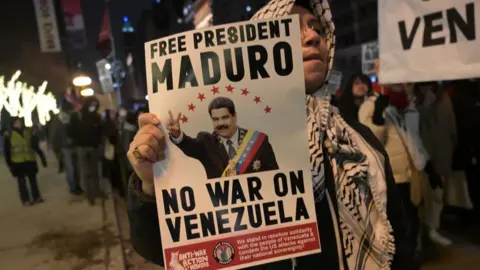
This past Monday, a shackled, jumpsuit-clad Nicholas Maduro stepped off a armed forces helicopter in New York City, surrounded by armed federal agents.
The Venezuelan president had remained in a infamous federal detention center in Brooklyn, prior to authorities moved him to a Manhattan federal building to confront legal accusations.
The chief law enforcement officer has stated Maduro was delivered to the US to "stand trial".
But legal scholars challenge the propriety of the administration's operation, and maintain the US may have violated established norms governing the military intervention. Domestically, however, the US's actions occupy a juridical ambiguity that may still culminate in Maduro being tried, regardless of the circumstances that delivered him.
The US asserts its actions were lawful. The executive branch has alleged Maduro of "drug-funded terrorism" and facilitating the movement of "thousands of tonnes" of narcotics to the US.
"All personnel involved acted professionally, firmly, and in strict accordance with US law and official guidelines," the Attorney General said in a official communication.
Maduro has consistently rejected US allegations that he oversees an criminal narcotics enterprise, and in court in New York on Monday he stated his plea of innocent.
Global Law and Enforcement Questions
While the charges are related to drugs, the US pursuit of Maduro is the culmination of years of criticism of his leadership of Venezuela from the United Nations and allies.
In 2020, UN investigators said Maduro's government had carried out "serious breaches" that were international crimes - and that the president and other top officials were involved. The US and some of its allies have also charged Maduro of manipulating votes, and withheld recognition of him as the rightful leader.
Maduro's purported connections to narco-trafficking organizations are the crux of this indictment, yet the US procedures in placing him in front of a US judge to answer these charges are also being examined.
Conducting a armed incursion in Venezuela and whisking Maduro out of the country in a clandestine nighttime raid was "completely illegal under the UN Charter," said a professor at a university.
Scholars pointed to a series of problems stemming from the US mission.
The United Nations Charter forbids members from the threat or use of force against other states. It permits "self-defence if an armed attack occurs" but that threat must be looming, professors said. The other exception occurs when the UN Security Council sanctions such an intervention, which the US did not obtain before it proceeded in Venezuela.
Treaty law would consider the illicit narcotics allegations the US alleges against Maduro to be a police concern, authorities contend, not a act of war that might permit one country to take armed action against another.
In official remarks, the administration has characterised the operation as, in the words of the Secretary of State, "basically a law enforcement function", rather than an declaration of war.
Precedent and US Legal Debate
Maduro has been indicted on drug trafficking charges in the US since 2020; the Department of Justice has now issued a revised - or revised - indictment against the Venezuelan leader. The executive branch argues it is now executing it.
"The operation was carried out to facilitate an pending indictment tied to massive drug smuggling and related offenses that have incited bloodshed, upended the area, and exacerbated the opioid epidemic claiming American lives," the AG said in her statement.
But since the mission, several scholars have said the US disregarded international law by removing Maduro out of Venezuela without consent.
"A country cannot go into another independent state and detain individuals," said an expert on international criminal law. "If the US wants to detain someone in another country, the proper way to do that is a formal request."
Even if an person is accused in America, "The United States has no authority to go around the world executing an detention order in the jurisdiction of other sovereign states," she said.
Maduro's lawyers in the Manhattan courtroom on Monday said they would dispute the propriety of the US mission which took him from Caracas to New York.
There's also a long-running legal debate about whether presidents must comply with the UN Charter. The US Constitution regards treaties the country ratifies to be the "supreme law of the land".
But there's a notable precedent of a former executive claiming it did not have to observe the charter.
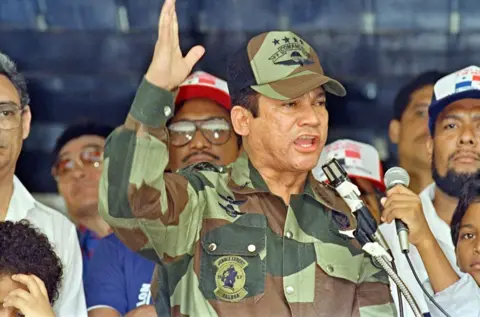
In 1989, the US government captured Panama's military leader Manuel Noriega and took him to the US to face drug trafficking charges.
An internal legal opinion from the time contended that the president had the executive right to order the FBI to arrest individuals who flouted US law, "regardless of whether those actions contravene customary international law" - including the UN Charter.
The draftsman of that memo, William Barr, was appointed the US attorney general and brought the first 2020 indictment against Maduro.
However, the memo's reasoning later came under questioning from academics. US courts have not made a definitive judgment on the question.
US War Powers and Jurisdiction
In the US, the issue of whether this action broke any domestic laws is complex.
The US Constitution gives Congress the authority to authorize military force, but puts the president in command of the military.
A War Powers Resolution called the War Powers Resolution places restrictions on the president's power to use armed force. It compels the president to notify Congress before sending US troops overseas "whenever possible," and report to Congress within 48 hours of committing troops.
The administration did not provide Congress a prior warning before the action in Venezuela "to ensure its success," a top official said.
However, several {presidents|commanders


