

Each autumn, South Korea comes to a standstill for its notorious college entrance exam.
Shops are shut, flights are delayed to minimize noise, and even the rhythm of the daily travel slows down for the students.
As evening approaches, most test-takers exit of examination centers, breathing a sigh of relief and greeting the family members standing by.
But not everyone finishes at that hour. After night has fallen and night has set in, certain test-takers remain in the testing hall – finishing close to 10pm.
These are the visually impaired examinees, who frequently spend more than 12 hours taking the most extended form of the Suneung.
The Endurance Examination
This week, over half a million students across the country will take the CSAT – a shortened form for university admissions exam in Korean. This represents the highest number of applicants in almost a decade.
The test not only dictates whether people will be able to enter college, but can affect their job prospects, income, where they will live and even personal connections.
Based on their subject choices, examinees complete roughly 200 questions across language, mathematics, English, social or natural sciences, an additional foreign language, and Hanja.
Typically, this constitutes an eight-hour marathon of consecutive exams. They begin the Suneung test at 8:40 AM and conclude approximately 17:40.
Visually impaired test-takers with significant sight challenges, though, are given almost double the regular exam time.
This means, when completing the additional foreign language part, the test can end as late as 21:48 – nearly 13 hours after it started.
There is no evening meal; the test proceeds uninterrupted.
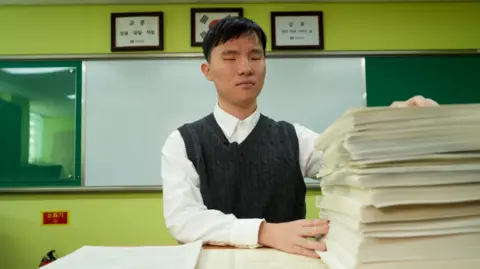
The physical bulk of the braille test papers further extends the duration.
When every sentence, symbol and chart is transformed into braille, every exam document becomes significantly more voluminous than the standard equivalent.
Student Perspectives
At Seoul Hanbit School for the Blind, teenage a student is one of the examinees who are preparing for the most extended form of the exam currently.
Previously, there were 111 blind test-takers nationwide – 99 with partial sight and 12 with complete visual challenges like Dong-hyun – according to data from educational authorities.
The student was visually impaired from birth and cannot distinguish light.
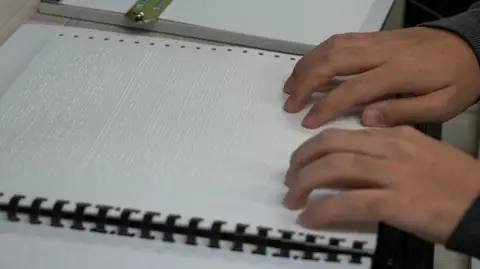
When meeting on campus, his hands moved rapidly across a braille practice booklet of past exam questions.
Approaching the examination date, he was focused on managing his stamina and physical state. He will take the exam using tactile materials and a audio assistance device.
"It's really exhausting because the exam is so long," he mentioned. "But there's no special trick. I simply adhere to my preparation plan and attempt to maintain my condition. That's the only way."
The student said the language component is especially challenging for him.
A standard test booklet for that section is about 16 pages – but the tactile edition is about one hundred pages long.
Even with screen-reading software, verbal content disappears as immediately after it is heard, unlike text that can be viewed and reviewed. Dong-hyun has to hold the details in his memory as he progresses.
The mathematics section is equally demanding.
He needs to comprehend detailed charts and data sets that have been converted into braille, using only his touch.
Nevertheless, he observed that things are better than they were previously. Historically, students had to do nearly every calculations in their memory. However, recently, visually impaired students have been allowed to use a tactile device, known as Hansone.
"Similar to sighted students write out their work in writing, we input them in braille on the Hansone to track progress," he said.

Physical Demands
Another student at Hanbit School, 18-year-old a test-taker, who will likewise complete the exam currently, mentioned the evening hours are "the hardest point" of the day.
"Before the midday break, it's tolerable," he stated. "But around 4 or 5pm, following language sections and prior to history, that's when the challenge intensifies.
"There's no dinner break," he elaborated. "We continue answering questions while we would typically dine, so it feels even more exhausting. Nevertheless, I keep going because I know there will be a feeling of achievement at the end."
For the student, the fatigue is intensified by the need to stay highly concentrated with both his hands and his hearing.
"While processing the braille with my fingers and also taking in content through sound, it feels significantly more exhausting than it does for sighted students," he described.
Accessibility Barriers
But the students explain that the length of the exam and the long study hours are not the primary challenge. What is most challenging is access to learning resources.
Common educational materials and online lectures that those with vision depend on are frequently inaccessible.
Limited numbers of tactile editions, and converting materials into audio requires having digital documents – which are hard to acquire. In many cases, someone has to personally input entire workbooks to create accessibility.
Online lectures also pose difficulties, as many instructors present information using written annotations, diagrams and graphics on display, which cannot be followed through sound only.
A major obstacle, though, is the postponement in receiving braille versions of the state-produced EBS preparation books – a core set of materials directly connected to the national exam.
Due to this postponement, blind students often receive the resources months later than others.
"Sighted students receive materials between January and March and study them for the whole year," said Jeong-won. "We obtain the tactile materials only around August or September, when the test is approaching quickly."
Dong-hyun expressed the identical worry.
"Tactile resources weren't ready before under three months prior to testing," he said. "I kept wishing the publication process could be faster."
The responsible organization, which creates the tactile edition of preparation resources, explained that the procedure takes at least 90 days for each book because it needs to adhere to relevant guidelines.
The organization added that it is "making various efforts to ensure that visually impaired examinees can study without disruption, including creating and supplying the materials in separate volumes."
An advocacy group said it has consistently presented this issue with {author


